What if depression and anxiety in young people aren’t signs that something is wrong with them, but proof that something is wrong with what we’re doing to them?
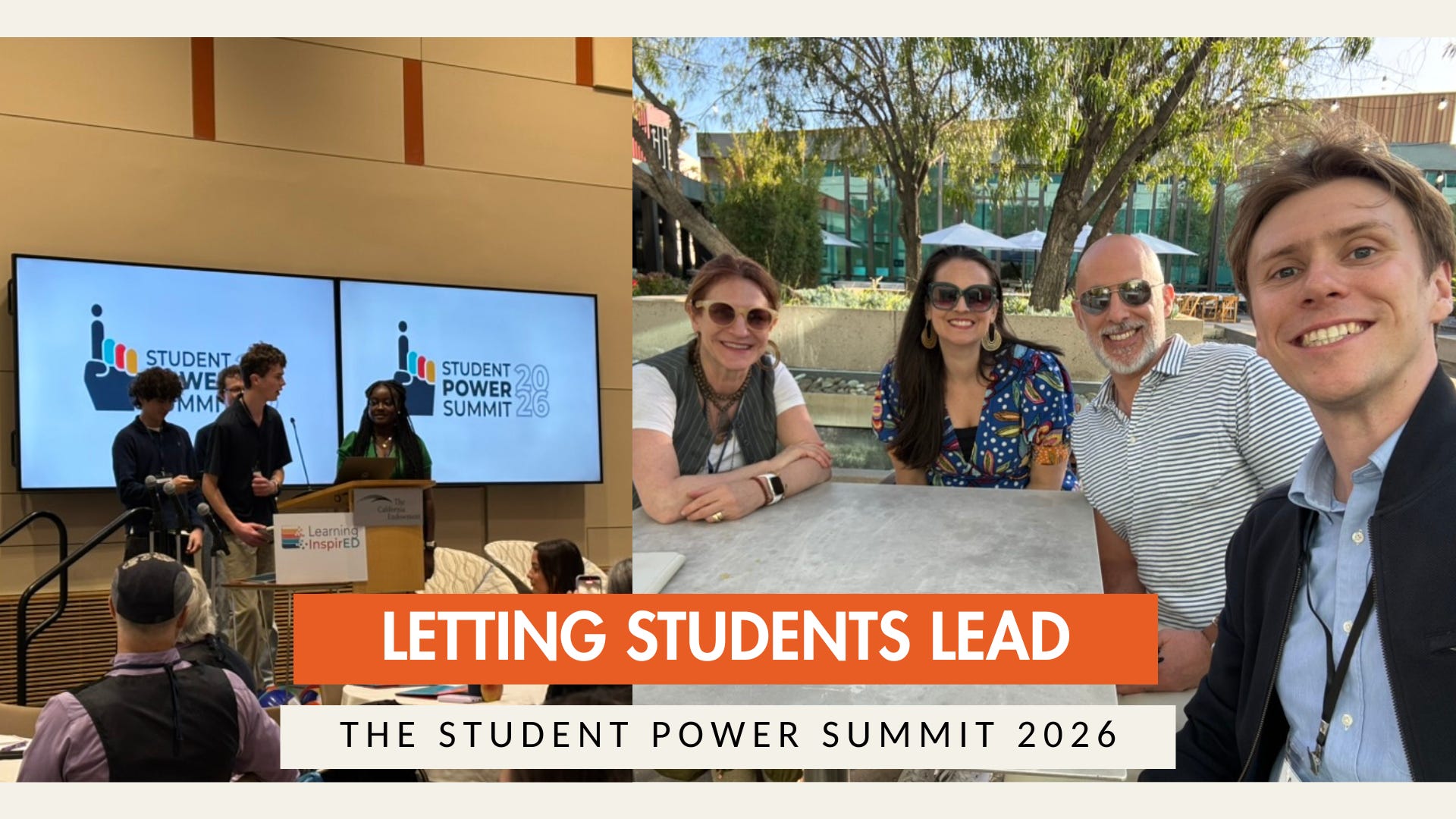
This is a special three-part episode recorded before, during, and after the Student Power Summit in Los Angeles: a conference that truly and authentically centered student voice. Students from across the country weren’t just in attendance, they were active participants in sessions, pushing back on what adults were saying, and ultimately presenting their own vision for what education should look like. You’ll hear that in the final segment, and it’s worth the wait.
Part one begins with my reflections on Johann Hari’s Lost Connections and the research showing that depression is not a chemical imbalance to be medicated away, but rather a response to environments that disconnect us from meaningful work, from each other, from our values, from the natural world, and from a hopeful future.
Sound like any institution you know?
Part two is a conversation with Jason Blair, an elementary art teacher from Columbus, Ohio, and Jennifer Goen, teacher and instructional leader at HB Woodlawn, a democratic school in Arlington, Virginia. Fresh off the first day of the summit and inspired by the partnership with Homeboy Industries, Jason and Jennifer dig into what happens when we start from strengths instead of deficits, why the arts hold a key that most schools throw away, and why efficiency may be the single greatest enemy of real learning.
Part three is the students themselves, and I’ll leave that for you to experience firsthand. They share clearly what they need in order to thrive.
I also want to share some key takeaways I had from the breakout sessions. Dr. Stuart Slavin, while leading a medical school, found that his students had skyrocketing anxiety and depression that only worsened each year. His response wasn’t to offer more counseling. He cut class time by 10%, made all courses pass/fail, freed up every other Wednesday for student-chosen pursuits, and reduced daily homework by one to two hours. Board scores rose. The failure rate was cut in half. Students left their first year of medical school less anxious than when they entered. His metaphor says it all: when the canaries started dying in the coal mines, miners didn’t give the canaries antidepressants. They got out of the mine. Our young people are the canaries. And yet we keep pushing deeper.
Slavin also names the toxic mindsets these environments produce: performance as identity, toxic comparison, maladaptive perfectionism, imposter phenomenon, self-blame, shame, and what’s known as the Stanford Duck: being calm on the surface, but with your feet paddling like crazy underneath. These aren’t personal failures. They’re the predictable outcomes of top-down, compliance-driven education.
I also had the privilege of meeting Nick Covington and Chris McNutt, cofounders of the Human Restoration Project, for the first time in person. Their work using empathy interviews to collect real-time data from students, and then using that data to reshape the experience of school in the image of the young people inside it, is incredibly powerful work. And they’re doing it in public schools that on the surface seem untouchable. When we change the kind of data we collect, and we have the right intention behind the reforms we pursue, remarkable things become possible.
Huge thanks to Mike Nicholson for organizing this truly incredible conference; the first I’ve attended that pushed meaningfully on the systemic implications of our schooling system with this kind of depth and honesty. And a special shout out to Dr. Mary Helen Immordino-Yang for a keynote that I hope to share parts of in a future episode.
There’s more footage from the summit coming. But for now, listen to what happens when we stop talking about students and start listening to them.
Want to hear more? Breaking The Paradigm will be LIVE, this afternoon, at 4:15pm!
We’ll be talking with the Montessori Public Policy Initiative about their upcoming advocacy day as part of the AMS Conference here in DC. Tune in on Substack, LinkedIn, or Riverside! See you then!
Are you a Montessori Adolescent educator or leader? Join our Montessori Adolescent Collaborative Forum!
Our Purpose:
Realizing Montessori’s vision of a new world starting with how we, as practitioners, transform through dialogue and community.
Why join the MAC Forum?
Build community: Connect with fellow adolescent guides from around the world.
Co-create the forum: Your questions, observations, and experiments shape the discussion.
Access the archive: Can’t make it live? All sessions recorded and available.
Forums are held virtually every second Tuesday at 7:00pm EST
Join Today and Find Your Community!
The traditional education system had its chance.
Now it’s our turn.