What is the best way to support students with diverse learning needs?
It’s the question that almost every educator I know is asking.
There’s a massive apparatus of intervention and support built around labels, diagnoses, and deficit-based thinking that was designed for conventional classrooms where compliance and uniformity are the goals. It’s referred to as the medical deficit model.
When that apparatus gets imported into Montessori environments, it doesn’t just fail to help our young people, it actively undermines the very things we know children need: autonomy, competence, and meaningful relationships.
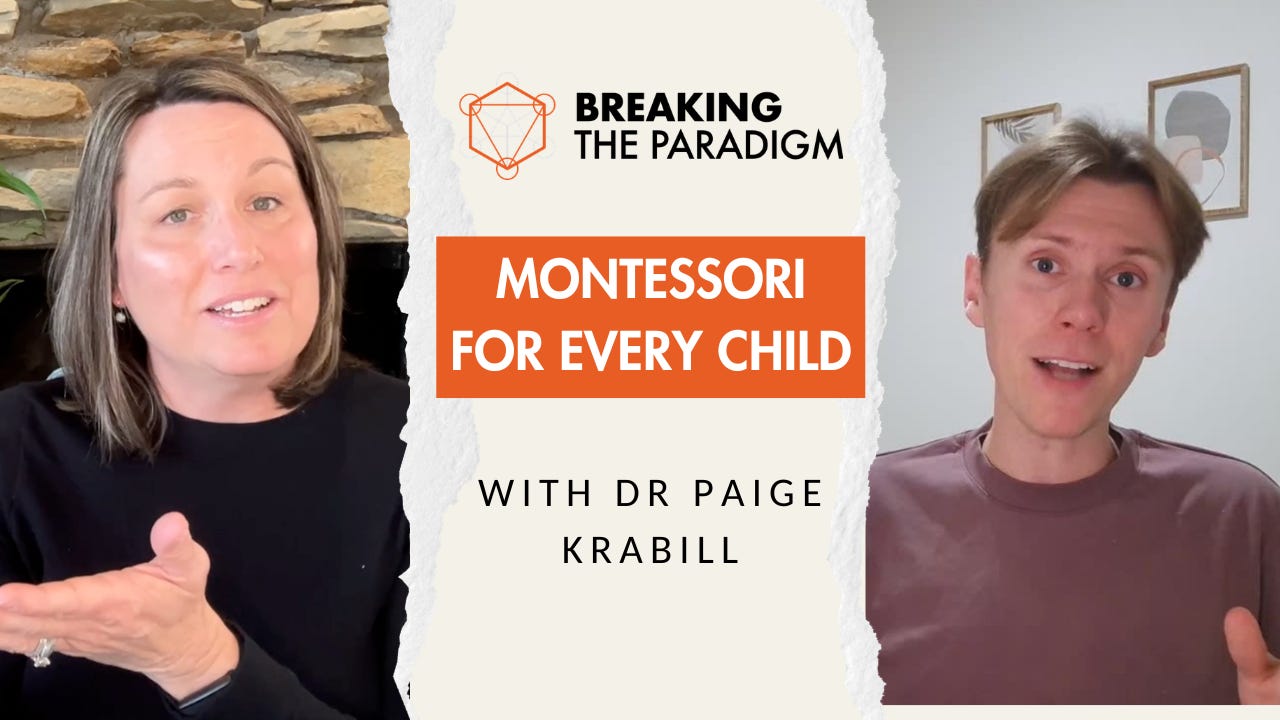
In this conversation, Dr. Paige Krabill and I explore what it looks like to reject that apparatus and to build something in its place that’s rooted in the Montessori philosophy, building on the strengths and gifts inherent in every young person while providing them the support they need to cultivate independence and autonomy.
Dr. Krabill is a clinical and school psychologist, an AMI-trained Montessori educator, and founder of PDK Educational Consulting. She spent the first chapter of her career working within the traditional intervention and support system, and kept hitting a wall.
It wasn’t until she walked into a Montessori classroom with her own child that she found the language she’d been searching for. That discovery eventually led her to develop the Power of Possibility framework and to begin building something new: the Montessori Institute of Northeast Ohio, a training center dedicated to reimagining what inclusion can look like when it’s rooted in Montessori philosophy rather than layered on top of it.
In this conversation, we dig into the cycle that so many schools get stuck in: how a behavioral manifestation leads to a label, which leads to separation, which leads to disconnection, which leads us to say Montessori “isn’t for this child.”
Paige names the myths that keep that cycle spinning and calls us back to something deceptively simple: presume competence, start with yourself, prepare the environment, and observe.
Montessori can (and should) be for every child, if we are willing to prepare environments to meet their needs.
What would it mean to stop educating diagnoses and start being in communication with the child in front of us? What becomes possible when we trade the language of deficits for the language of aid to life, and when we trust that the prepared environment can do what no checklist of strategies ever could?
This is a conversation about our spiritual preparation as adults; the kind that has to be practiced daily, that works against the grain of enormous systems, and that changes everything when we commit to it.
Thanks, Paige for a great conversation!
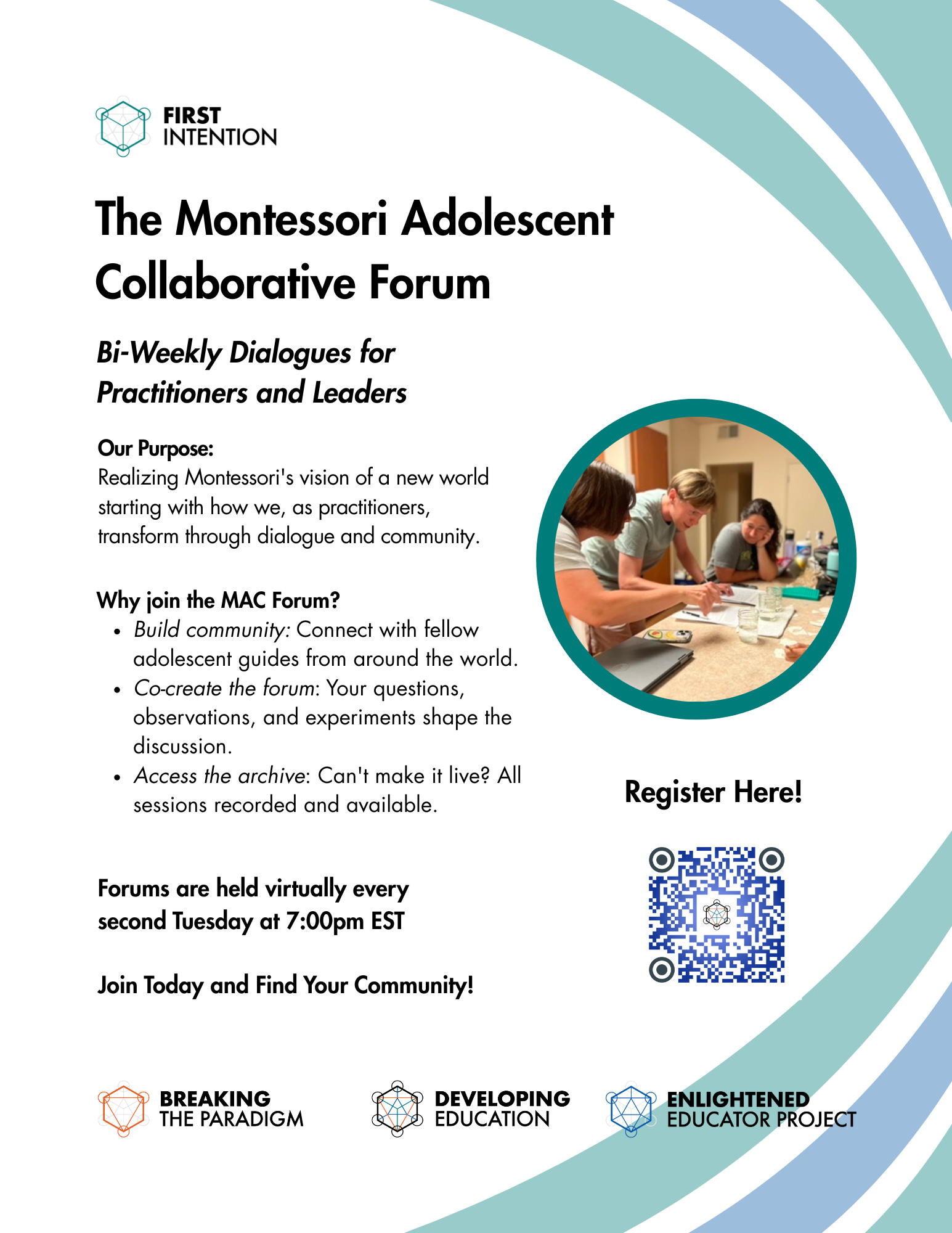
Are you a Montessori Adolescent educator or leader? Join our Montessori Adolescent Collaborative Forum!
Our Purpose:
Realizing Montessori’s vision of a new world starting with how we, as practitioners, transform through dialogue and community.
Why join the MAC Forum?
Build community: Connect with fellow adolescent guides from around the world.
Co-create the forum: Your questions, observations, and experiments shape the discussion.
Access the archive: Can’t make it live? All sessions recorded and available.
Forums are held virtually every second Tuesday at 7:00pm EST
Join Today and Find Your Community!
The traditional education system had its chance.
Now it’s our turn.