Concentric Circles of a Harkness Table
An Experience of Independence and Interdependence

In her reflections on the Harkness method in the article “The Art of Listening,” Phillips Exeter instructor Nita Pettigrew wrote the following:
“A teacher-framed, teacher-centered classroom, I have come to realize, may be well intentioned, but it misses the point; to deliver information is not necessarily to build knowledge or understanding… My present practice is based on several fundamental insights:
Learning is a personal journey, guided by each individual’s unique way of thinking, and colored by each individual’s unique perspective.
When we understand something, we own it, and the pleasure of ownership is visceral- not merely intellectual.
The ideas that are dearest to us, ones that become internalized and useful, are the ones we have struggled personally to build.”
Over the last six years, I’ve used the Harkness method of discussion in 12-15 and 15-18 Montessori environments. I have found that it is a better fit with Montessori philosophy than a Socratic seminar because it removes the adult completely: Students in a Harkness seminar are responsible for leading their discussions entirely on their own. The guide prepares students in advance of the seminar and helps the group reflect afterwords, but ultimately allows the students to self-direct during the discussion.
I utilize the Harkness method because I seek to prepare an environment which empowers my students to discover and negotiate meaning, truth, beauty, joy, morality, ethics, and understanding on their own through the habits they build around the table. This process is aided by a guide but should ultimately continue without me as an aid to life.
The prepared environment for the Harkness method is both physical and intellectual. Sitting around one table, facing each other, with the guide stepping back to allow the students to lean in, is the most visible part. The intellectual environment, however, is just as important: the seminar table tracker, the student self-evaluation, the pre-discussion preparation, and the post-discussion reflection.
Like Montessori education, Harkness is designed to be a holistic, humanizing method.
Rather than just an academic exercise, Harkness is an experience in independence and interdependence.
The students will need to be able to self-direct their own learning by completing the reading, seeking help if needed, and preparing adequately for the discussion. They must also work interdependently with their peers, in order to make the text “bigger” than it was when they arrived at the table. Only through interdependent dialogue can the community dig for deep meaning. In order to achieve such results, the following four “concentric circles” should be given considerable attention by the Harkness guide. These concentric circles are adapted from the excellent book Street Data and applied to the Harkness method.
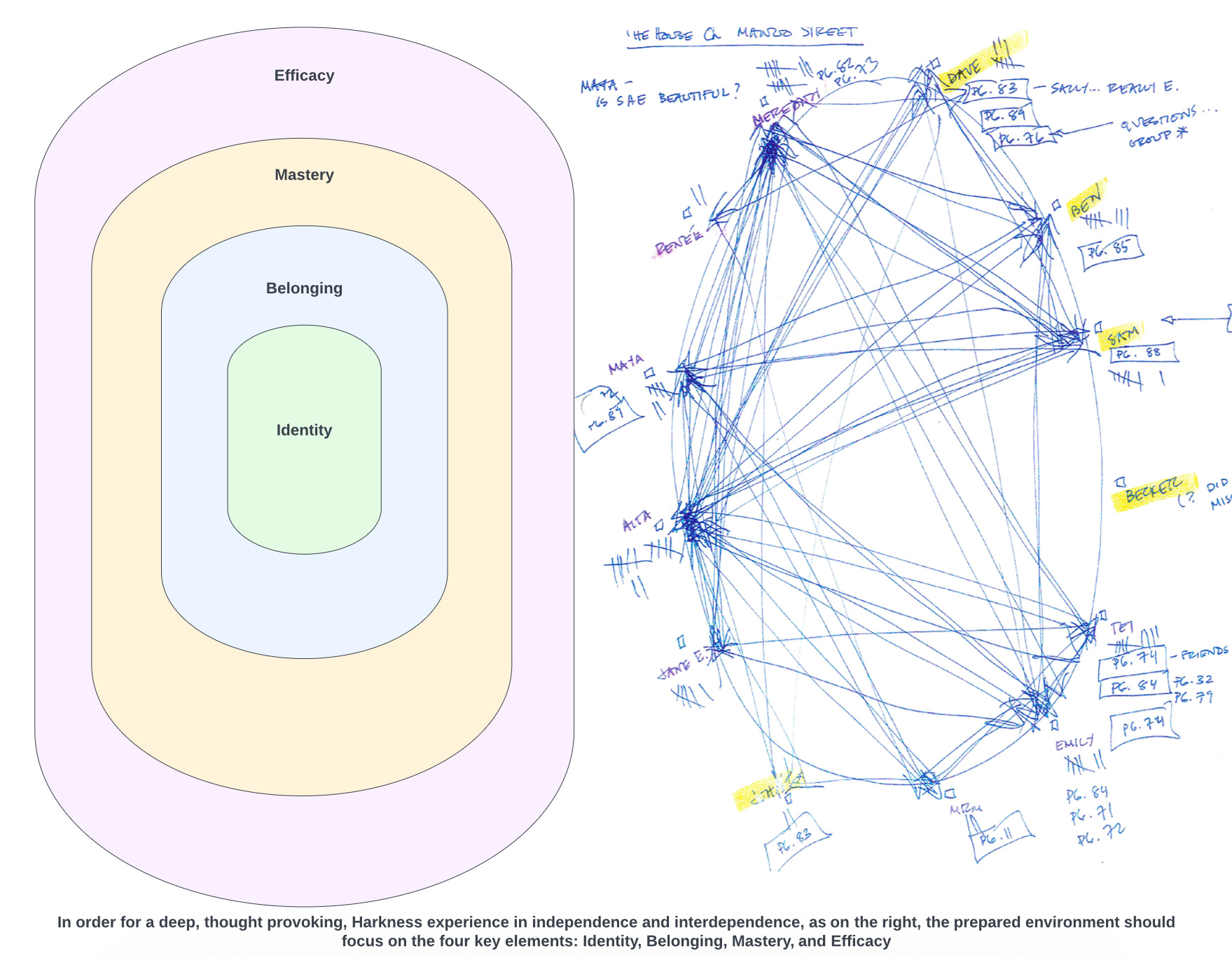
Identity:
Identity is the first concentric circle, because without students being comfortable with themselves, their beliefs, and their values, the vulnerability needed for a successful Harkness discussion will not emerge. This identity work is happening across the curriculum and also within the Harkness space. Sharing with students that equity of voice is the goal means that each person needs to bring their unique self to the conversation to be as rich as possible.
The space should be curated, by both the guide and students, so that each participant is confident in who they are and their emerging sense of values and opinions.
Belonging:
For adolescents, belonging in their community is essential to their learning and wellbeing. The prepared environment, including the seminar preparation, rubric, and group evaluation, are designed to coach the students to create a community for themselves where they all belong.
This is not something the guide can simply create create.
In this sense, belonging and efficacy are two mutually reinforcing elements: each student must feel a responsibility to make sure that everyone belongs at the table, and through the efforts of their peers, each student feels more comfortable and vulnerable.
Mastery:
Mastery, predicated on the other concentric circles of the method, is where the academic magic happens. While students may not follow your line of inquiry as the guide, they will be challenging each other to use the Harkness skills and habits that have been reinforced by the prepared environment on their own terms and toward their own line of inquiry. This does not mean that you cannot modify the prepared environment to make sure that students understand certain concepts and discuss certain ideas. However, respecting the students’ inquiry is of paramount importance for mastery to truly emerge. In order for the discussion to truly be theirs, they must have the freedom to discuss their ideas as they see fit.
Efficacy:
The reason that the guide steps back from a Harkness discussion is so that students can take responsibility for their learning. Much like the Montessori environment, students do not “do the reading” for the guide; they do it because they have an intrinsic desire to learn and create new knowledge with their peers.
In a Harkness discussion, students are also responsible for each other. Adolescents are social beings, and the Harkness method taps into that developmental task, which is where the independence of working toward your own identity, belonging, and mastery meets the interdependence of the table. Students quickly learn that a seminar where only one or two students speak, no matter the depth of contributions from those individuals, is not a successful seminar. This experience in interdependence through Harkness reinforces Montessori’s ideal of a community of adolescents that must learn to live and grow interdependently together.
Want to hear about my own personal story of adopting Harkness? Check it out below!
Educators: Are You a Choreographer or a Coach?

In my early years as an educator, I worked tirelessly outside of school hours to develop my curriculum and pedagogy. On one night in particular, I was struggling to develop the perfect plan for the following day. As it was getting late, my wife asked me:
Are you a Montessori Adolescent educator or leader? Join our Montessori Adolescent Collaborative Forum!
Our Purpose:
Realizing Montessori’s vision of a new world starting with how we, as practitioners, transform through dialogue and community.
Why join the MAC Forum?
Build community: Connect with fellow adolescent guides from around the world.
Co-create the forum: Your questions, observations, and experiments shape the discussion.
Access the archive: Can’t make it live? All sessions recorded and available.
Forums are held virtually every second Tuesday at 7:00pm EST
Join Today and Find Your Community!
The traditional education system had its chance.
Now it’s our turn.